Learn auscultation
by ear.
Ausculta is an educational atlas for learning auscultation. It contains 42 textbook heart, lung and bowel sounds from open research databases, each with a description, source and licence, and 4 ECG examples with heart sound. You also find the sounds on a map of the auscultation sites, practise with a quiz, short cases and daily practice with spaced repetition, and the guide reminds you where and how to listen with a stethoscope. The app does not use the microphone and measures nothing. It is in Slovak, English, Czech and German, and free to download.
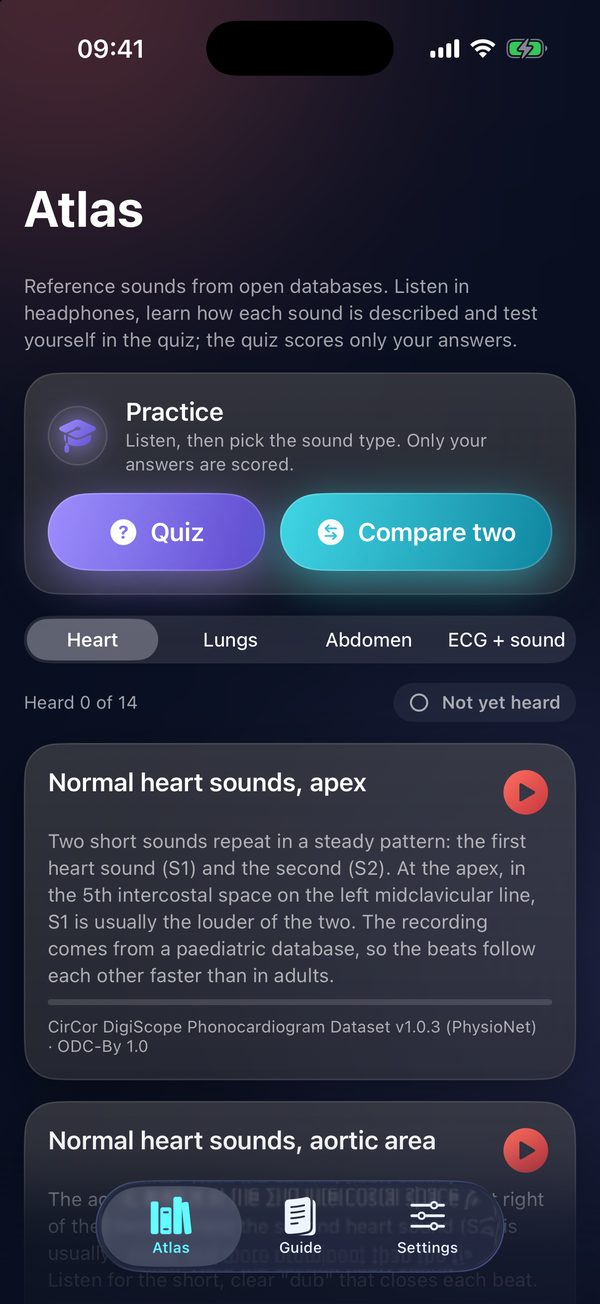
Auscultation is learned with your ears. First you listen to an example with its description, then you recognise it without one, and finally you tell it apart from a similar one. Ausculta plays the examples in your headphones whenever and as often as you need. And then… …in hands-on teaching with a stethoscope you already know what to listen for.
A skill that is slipping out of training
Auscultation remains the first choice at the bedside and in the field: it is cheap, immediate and available even where there is no echocardiography. Mastering it, however, takes many repetitions, and chances to listen at the bedside are getting fewer. Ausculta helps you train your ear: an atlas of textbook examples from open databases that you can play again and again, a quiz that shows what you already recognise, and daily practice that brings the sounds back after a few days.
Recognition is poor and barely improves with years of training
Mangione and Nieman tested 453 physicians in training and 88 medical students on 12 cardiac findings recorded from patients: internal medicine and family practice residents recognised on average 20 % of them, with little change by year of training. In a second study (656 physicians in training and 194 medical students), residents recognised on average fewer than half of 10 lung findings, again with little improvement during training. A later test of 860 participants showed that cardiac examination skills do not improve after the third year of the four-year US medical course, not even in residents and practising physicians; only cardiology fellows did better.
Repetition works
Barrett and colleagues had 51 second-year medical students listen to each of four basic murmurs 500 times: accuracy rose from 13.5 % to 85 % (monitored) and from 20.9 % to 86.1 % (unmonitored); the control group did not improve significantly (24 % to 32 %). Auscultation is in part a technical skill learned by repetition. Ausculta is built for that kind of repetition: an atlas you can play a hundred times, a quiz that shows what you already recognise without the description, and daily practice that brings the sounds back at spaced intervals.
The trend points down
At one US academic centre, the scores of students and physicians in training in a cardiac auscultation simulation test fell between 2008 and 2018 by 0.15 points a year (a 16-sound test, mean 7.7 points; 411 tests, 85 % of them medical students). Echocardiography has not replaced auscultation, it has complemented it: the ear at the bedside often helps decide who to refer, and when.
Sources: Mangione S, Nieman LZ. JAMA. 1997;278(9):717-722 (PMID 9286830). Mangione S, Nieman LZ. Am J Respir Crit Care Med. 1999;159(4):1119-1124 (doi:10.1164/ajrccm.159.4.9806083). Vukanovic-Criley JM et al. Arch Intern Med. 2006;166(6):610-616 (doi:10.1001/archinte.166.6.610). Barrett MJ et al. Chest. 2004;126(2):470-475 (doi:10.1378/chest.126.2.470). Zhang NS et al. Am Heart J. 2025 (doi:10.1016/j.ahj.2025.03.006). Verified in PubMed on 24 October 2026.
How to learn with the atlas
The atlas is built on repetition: listen, read the description, slow down what escapes you, test yourself and come back to what has not clicked yet.
Listen with the description
Listen to each example several times in headphones with the description open, until you can recognise it without reading. Headphones bring out quiet sounds too, such as a third heart sound or fine crackles; the examples also play through the speaker.
Slow down and watch the waveform
For fast or complex examples switch the speed to 0.75× or 0.5×: the pitch does not change, you just have more time for each sound. Drag on the waveform to loop the stretch that escapes you. In the annotated examples, follow the S1 and S2 marks or the stretches of wheezes and crackles.
Test yourself in the quiz
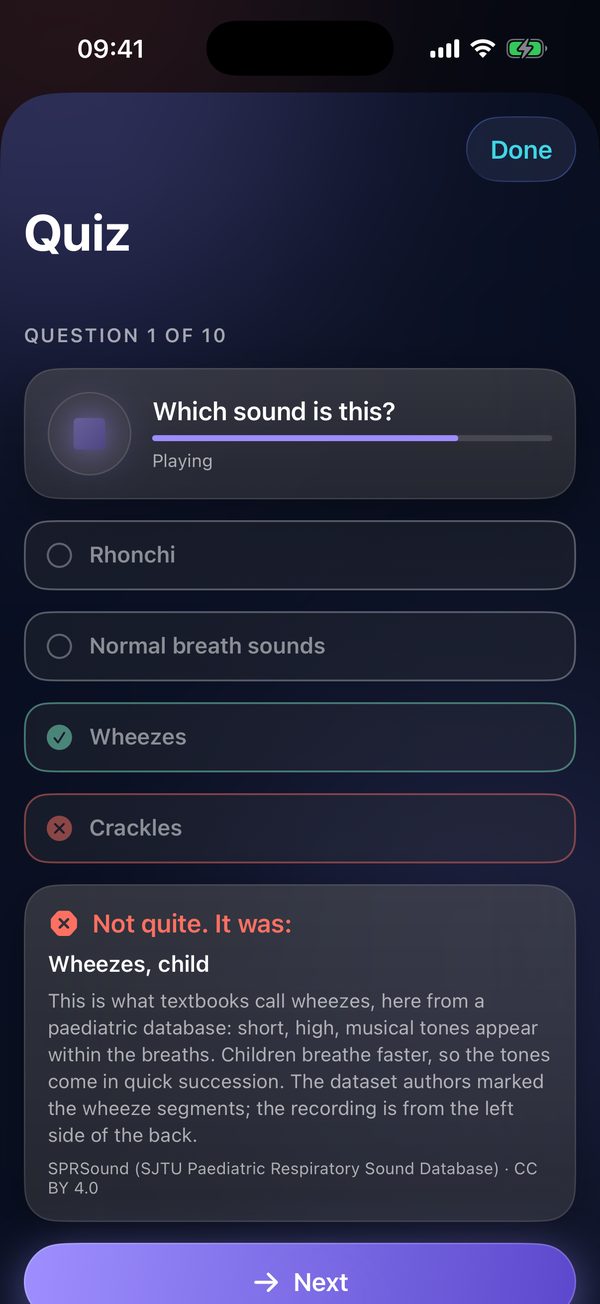
The quiz plays an example and you pick the type of sound from up to four names. You see right away whether you were right, along with the textbook description. Only your answers are scored.
Walk through a case
A case leads you across the marked sites on the map as at the bedside: at each one you listen to an example and name the type of sound. It is a way to link a sound with the place where it is heard.
Compare two examples
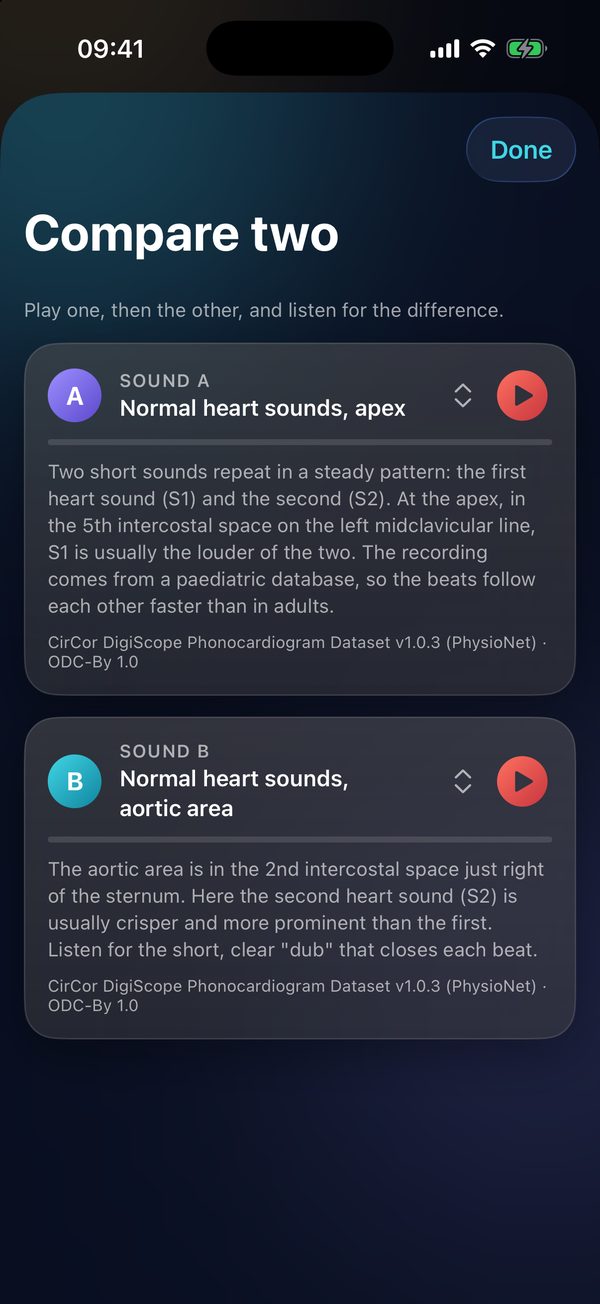
Compare two plays two examples side by side, for example normal breathing and wheezes, or fine and coarse crackles. Play one, then the other, and notice what sets them apart.
Come back in daily practice
Daily practice prepares at most 20 examples a day: first the ones due for review, then new ones. Sounds you name correctly come back after a growing number of days, the ones you get wrong in the very next session. The “Heard X of Y” overview and the “Not yet heard” filter show what you are still missing in the atlas.
What Ausculta offers
Atlas of reference sounds
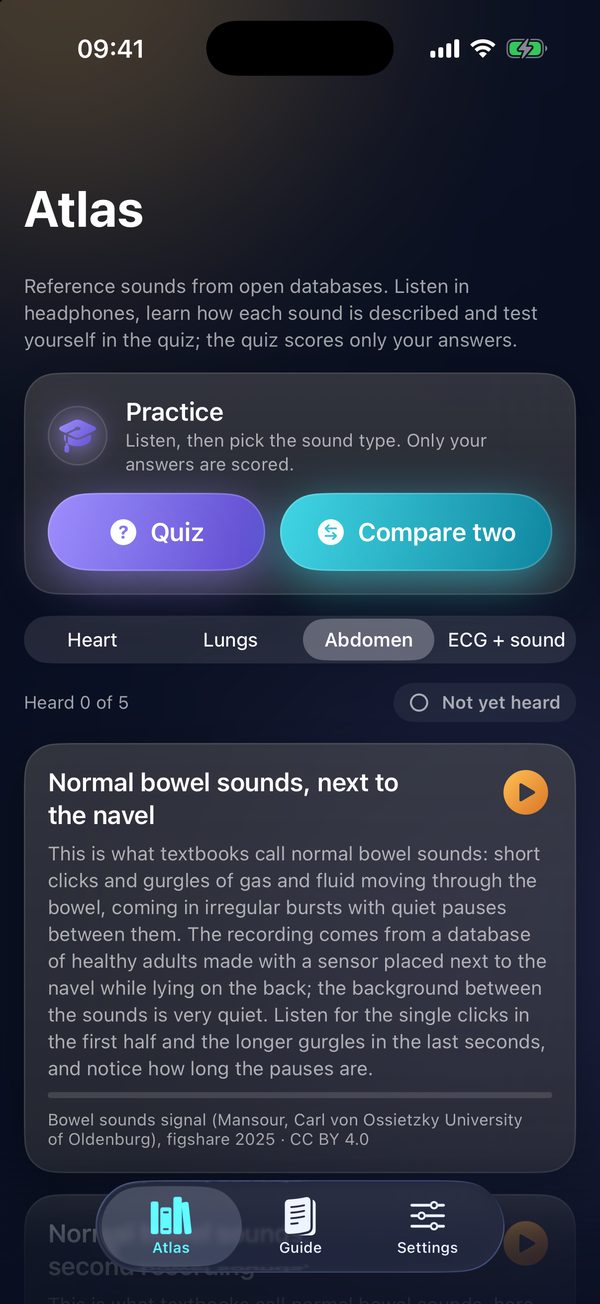
42 textbook heart, lung and bowel sounds from open research databases (PhysioNet and others; one bowel sound example comes from the freesound.org sound library). Each has a description, source and licence. They play in headphones or through the speaker.
Heart, lungs and abdomen
Normal heart sounds from different listening sites, systolic and diastolic murmurs, third and fourth heart sounds; vesicular and tracheal breathing, wheezes, rhonchi, crackles and stridor; normal bowel sounds and borborygmi. The description explains what you hear in each example.
Playback tools
Every example has a waveform with a playback cursor, slower playback at 0.75× and 0.5× without a change in pitch, a loop over a chosen stretch (drag on the waveform) and the Wide, Bell and Diaphragm filters. In 20 examples the waveform carries S1 and S2 marks or stretches of wheezes, crackles, rhonchi, stridor, inhalation and exhalation taken from the annotations of the source databases. All of it works on the recording only; nothing is measured.
Quiz and comparison
The quiz plays an example and you pick the type of sound; the textbook description follows right away. Only your answers are scored. Compare two plays two examples side by side, and the app remembers which examples you have already heard.
Daily practice
Spaced repetition over the atlas sounds: a sound you name correctly comes back later (after 1, 3, 7 and then 14 days), a sound you get wrong comes back in the very next session. A daily session has at most 20 examples, first the ones due for review, then new ones. The overview shows your accuracy by type of sound over the last 30 days. Your progress stays on the phone.
ECG and heart sound
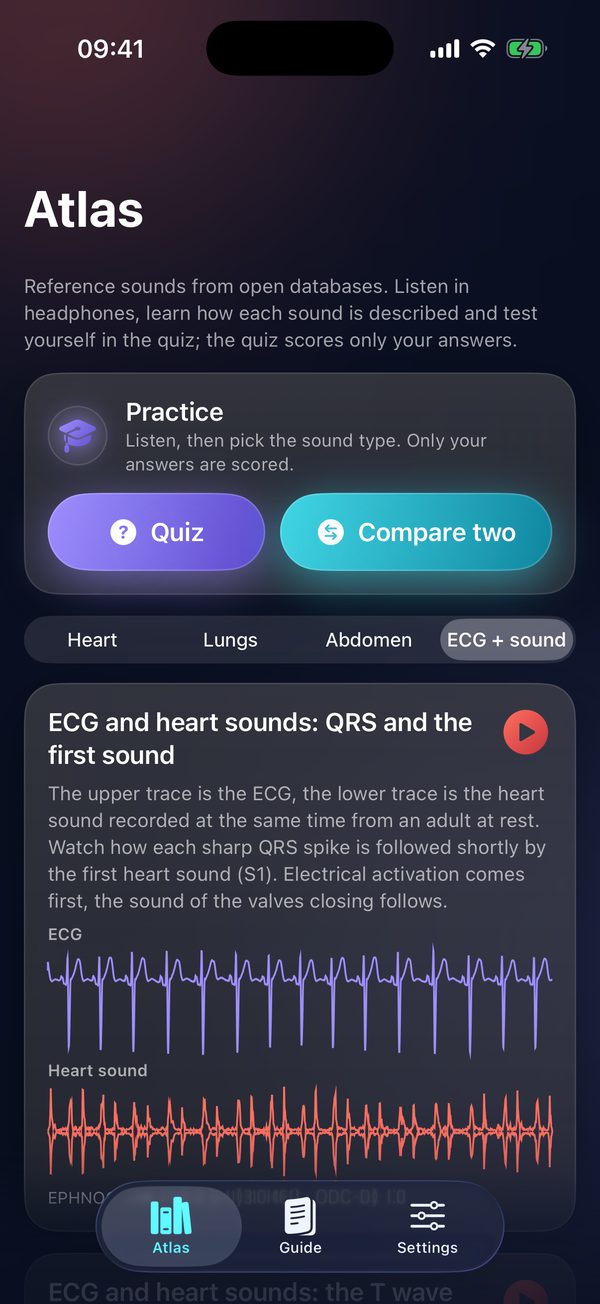
4 examples from an open database in which the ECG and the heart sound were recorded together. You see them one above the other on one time axis and, during playback, follow how the heart sounds come after the electrical activation. Nothing is measured in the examples.
Stethoscope guide
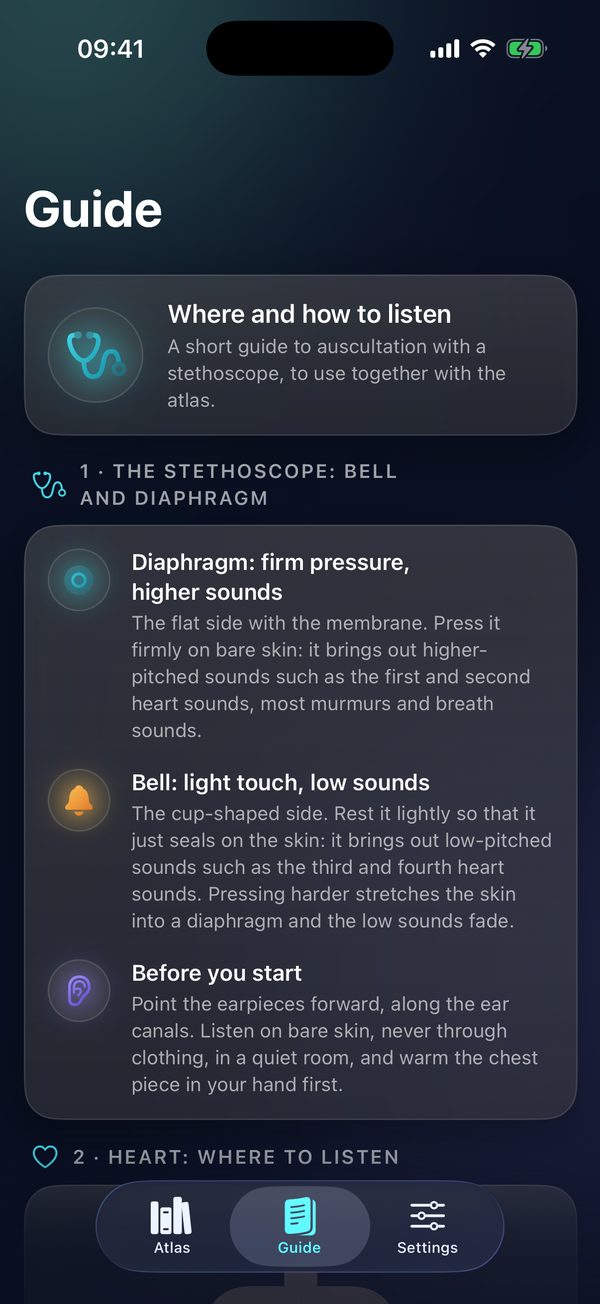
Where and how to listen with a conventional stethoscope: bell and diaphragm, pressure, auscultation sites of the heart and lungs, the four abdominal quadrants and how long to listen. As background for the atlas.
Four languages
Ausculta is in Slovak, English, Czech and German and follows the language of your iPhone. The descriptions, the quiz, the cases and the guide are in all four languages.
Privacy
The app does not use the microphone, has no account, server or analytics and collects no data. Your practice progress stays on the phone. Purchases are handled by the App Store.
Site map
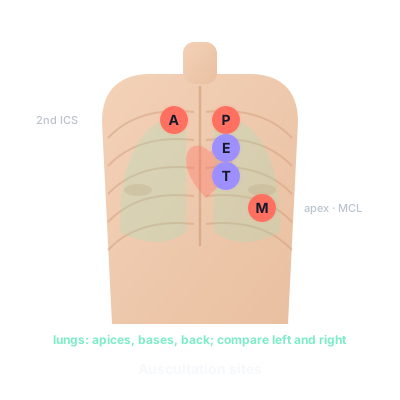
A drawn chest, front and back, and abdomen with the auscultation sites: A aortic, P pulmonic, E Erb's point, T tricuspid, M apex; lung apex, side of the chest and lung base, back and trachea; next to the navel. Tapping a site opens the examples that, according to the source database, were recorded there, together with the playback tools. The app never guesses a site: examples appear only at the sites the source states, which is why Erb's point, for example, has no example yet.
Cases
Six short textbook situations built only from atlas examples: a fellow student and four heart sites, a child at a check-up, a child with noisy breathing, an adult with a cough, an adult listened to with the bell at the lower left sternal border, and the abdomen before and after a meal. You walk through the marked sites, listen to an example at each one and name the type of sound; at the end you see what you got right. The cases are not real patients and only your answers are scored.
Where and how to listen
A short guide to auscultation with a conventional stethoscope, as background for the atlas. In the app it is in the Guide tab.
Before you start
Point the earpieces forward, along the ear canals. Listen on bare skin, never through clothing, in a quiet room, and warm the chest piece in your hand first.
Diaphragm: firm pressure, higher sounds
The flat side with the membrane. Press it firmly on bare skin: it brings out higher-pitched sounds such as the first and second heart sounds, most murmurs and breath sounds.
Bell: light touch, low sounds
The cup-shaped side. Rest it lightly so that it just seals on the skin: it brings out low-pitched sounds such as the third and fourth heart sounds. Pressing harder stretches the skin into a diaphragm and the low sounds fade.
Heart and lungs
A aortic area (2nd intercostal space, right sternal border), P pulmonic (2nd intercostal space, left), E Erb's point (3rd intercostal space, left), T tricuspid (4th-5th intercostal space, left sternal border), M apex (5th intercostal space, left midclavicular line). At every site listen with the diaphragm first, then with the bell at the apex and the left sternal border; identify S1 and S2 first, then extra sounds and murmurs. Listen to the lungs with the diaphragm from the apices to the bases, front, sides and back, always comparing the left and right side at the same level.
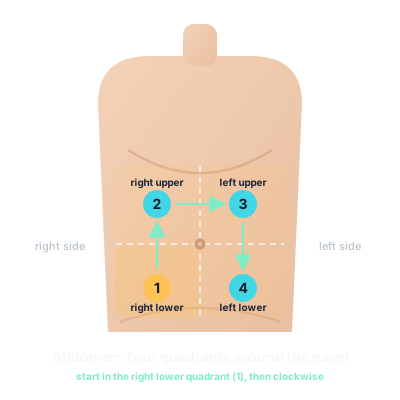
Abdomen
The person lies on the back with a relaxed abdomen. Start in the right lower quadrant and go on clockwise through all four. Listen before you press on the abdomen, with the diaphragm resting lightly on bare skin. Bowel sounds come in irregular bursts: stay at each place until you hear several bursts, usually up to a minute.
Free and Ausculta Pro
Ausculta is a free download. Ausculta Pro is a one-time in-app purchase, not a subscription.
Free
12 of the 42 atlas sounds, all 4 ECG examples with heart sound, the site map, cases, quiz, daily practice and Compare two with the free examples, the playback tools, the overview of examples you have heard and the whole guide.
Ausculta Pro
Unlocks the other 30 atlas sounds, which then also appear on the map, in the quiz, in the cases, in daily practice and in Compare two. One-time purchase; the App Store shows the price in your local currency.
A voluntary contribution to development and maintenance (Support development) unlocks nothing. If you wish, it supports further work on Ausculta.
Who is behind it
MUDr. Ján Šikuta, PhD.
Author of the idea and the teaching concept: atlas, quiz and guide.
Breathune
Design and development of the app, preparation of the atlas sounds.
Who it is for
For medical and nursing students and for the curious who want to learn to listen.
Collaboration on teaching auscultation or choosing the examples: admin@breathune.eu